Moroccan Ports Drive the New Green Hydrogen Value Chain
A new World Bank study highlights the central role that Moroccan ports can play in the development and trade of green hydrogen and hydrogen-based fuels.
With its strategic geographic location and abundant renewable resources, Morocco is well positioned to meet the growing global demand for clean energy solutions. As part of the “Morocco Offer,” the Kingdom aims to develop high-performance port infrastructure across the country, laying solid foundations for the growth of the green hydrogen sector.
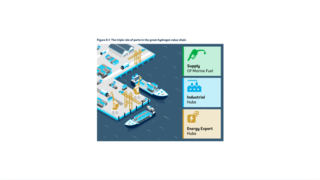
According to the report, Moroccan ports can play a triple role:
- Supplying green fuels to the maritime transport sector, where demand could increase significantly by 2050;
- Supporting the decarbonization of national industry, particularly fertilizers and steel production;
- Serving as export hubs to Europe, in a context of strong demand for green hydrogen.
The study analyzes four key ports, Tanger Med, the Port of Mohammedia, the Port of Jorf Lasfar, and a port located near Tan-Tan, and identifies their potential to build an integrated hydrogen value chain, in line with national ambitions.
The most competitive scenario proposed by the World Bank foresees hydrogen production near Tan-Tan, where costs are the most competitive, followed by transportation via pipeline to the Port of Mohammedia. The hydrogen would be stored in Mohammedia’s salt caverns before being distributed to ships and industrial users, notably in Tanger Med and Jorf Lasfar, and then exported from an Atlantic port capable of handling large tankers, potentially Tan-Tan after modernization.